


The Moment We’re In - and How We Got Here
Part of the Meeting the Moment compilation, curated by Building Beyond Policing and Democratizing Justice Initiative. Read the entire issue:
As the United States careens toward authoritarianism, the role of law enforcement as an enforcer of a specific political agenda — backed by ever-expanding powers, funding, militarization, and surveillance infrastructure — has never been clearer. But this ominous trend is not limited to federal law enforcement under the Trump regime; it mirrors the trajectory of the New York Police Department, which has long embodied authoritarian tendencies. This critical moment demands a clear assessment of what is (and isn’t) new, how we got here, and the interconnected nature of our struggles, and it necessitates organized and coordinated interventions across multiple fronts.
The United States was built through settler colonialism, ethnic cleansing, and the stolen labor of enslaved people. To maintain power and continue to extract profit, the state has always used violence and coercion, from slave patrols and forced Indigenous boarding schools to Jim Crow laws and voter suppression, to today’s regime of mass incarceration, detention, and deportation. Under the thinly veiled guise of “safety,” law enforcement was created to carry out the state’s will, even (and often) at the expense of people’s freedom and well-being. The decades-long normalization of state violence has helped lay the foundation for the MAGA authoritarian takeover we are currently struggling to resist.
While there are ways in which Trump’s anti-immigrant agenda can be understood as the newest versions of the United States’ practiced systems of exploitation, oppression, punishment, and social control under racial capitalism, we feel in our bones that things are different: more accelerated, more terrifying, more out of control.
Part of what distinguishes this moment is that those in power now have the technology to automate social control and profit from it faster than ever before. The state can map out, with a few clicks, who you know, track your location, and evaluate if even your thoughts — let alone your actions — are “acceptable.” Suppressing dissent is a pillar of authoritarianism, necessary for controlling the narrative and eliminating opposition in order to keep the path clear to further exploit people and the land for profit. When people resist, they face repression, which too often turns deadly, as in the cases of Tortuguita, Renee Good, and Alexi Pretti. The same technology being used to surveil us is also livestreaming these images of people being kidnapped, beaten, bombed, and killed. Far from incidental, these spectacles of violence serve as constant reminders of the very real threats we face if we dissent, hold certain identities, or simply end up in the wrong place at the wrong time. They reveal just how disposable we are in a system increasingly dominated by apocalyptic billionaires, far-right populists, and Christian nationalists, and they are organized to ensure the elite few have the most possible as the world falls apart.
Through this rapidly accelerating surveillance and misinformation machine, the Trump regime and its plutocratic associates are amassing massive wealth: private companies profit from detention, tech companies get rich off our data, and this wealth accumulation circles back to feed the flywheel of social control, as evidenced by the gutting of journalism by billionaires. While most of us struggle to meet our basic needs, the same elites investing in surveillance, detention, and border militarization insulate themselves from the crises their policies help produce. In this worldview, crisis is not something to solve collectively but something to weaponize — a justification for repression, exclusion, and the concentration of power in the hands of those who claim they alone can protect “the deserving” from everyone else.
Technology is not the only force defining this moment. The consolidation of white nationalist populism, while not new, has renewed vigor and influence and is cohering into fascist governance. The current Trump regime has coupled its technical and military resources with an all-out attack on democratic institutions, gutting multiple agencies and replacing even minor opponents with powerful allies. Combined with the isolation of the 21st century and growing wealth gap, the unabashed othering of Black, brown, poor, trans and nonbinary, and other marginalized folks projects a zero-sum world — one where survival for some is premised on the disposability of others. The omnipresent threat of punishment, or even the fear of it, perpetuates division and prevents us from pursuing the solidarity organizing that could lead to meaningful change. In this end-times framework, fragmentation is not incidental but essential: it ensures that collective resistance is weakened precisely when it is most necessary.
Where are we headed if we don't organize?
This era of social media-length attention spans makes it all the more likely that we will settle for ahistorical interpretations of the present. That’s how you get the same people who were in the streets in 2020 demanding to defund the police now buying into liberal narratives like “ICE isn’t law enforcement” and that we need local departments to “police ICE.”
In reality, the evidence that local law enforcement serves national agendas is right in front of our faces. Immigration and Customs Enforcement (ICE) has always depended on local policing to make people more deportable through arrests, convictions, and the steady flow of information. Even in a “sanctuary city,” since the U.S. Department of Homeland Security’s creation, the NYPD has been feeding the deportation machine through its broken windows targeting of immigrant communities and regular collaboration with federal agencies.
Today, that collaboration is even more visible. The NYPD and federal agencies operate joint task forces and share intelligence, creating channels for federal authorities to directly access local police operations. The NYPD violently cracks down on anti-ICE protestors and clears the way for ICE to make arrests. The NYPD’s expansive surveillance systems — including license plate readers, facial recognition, and gang databases — collect and circulate vast amounts of data that can be accessed and manipulated by federal authorities. In practice, a single police encounter — a stop, summons, arrest, or entrance into a database — can trigger a chain of information sharing that exposes someone to ICE regardless of formal sanctuary policies.
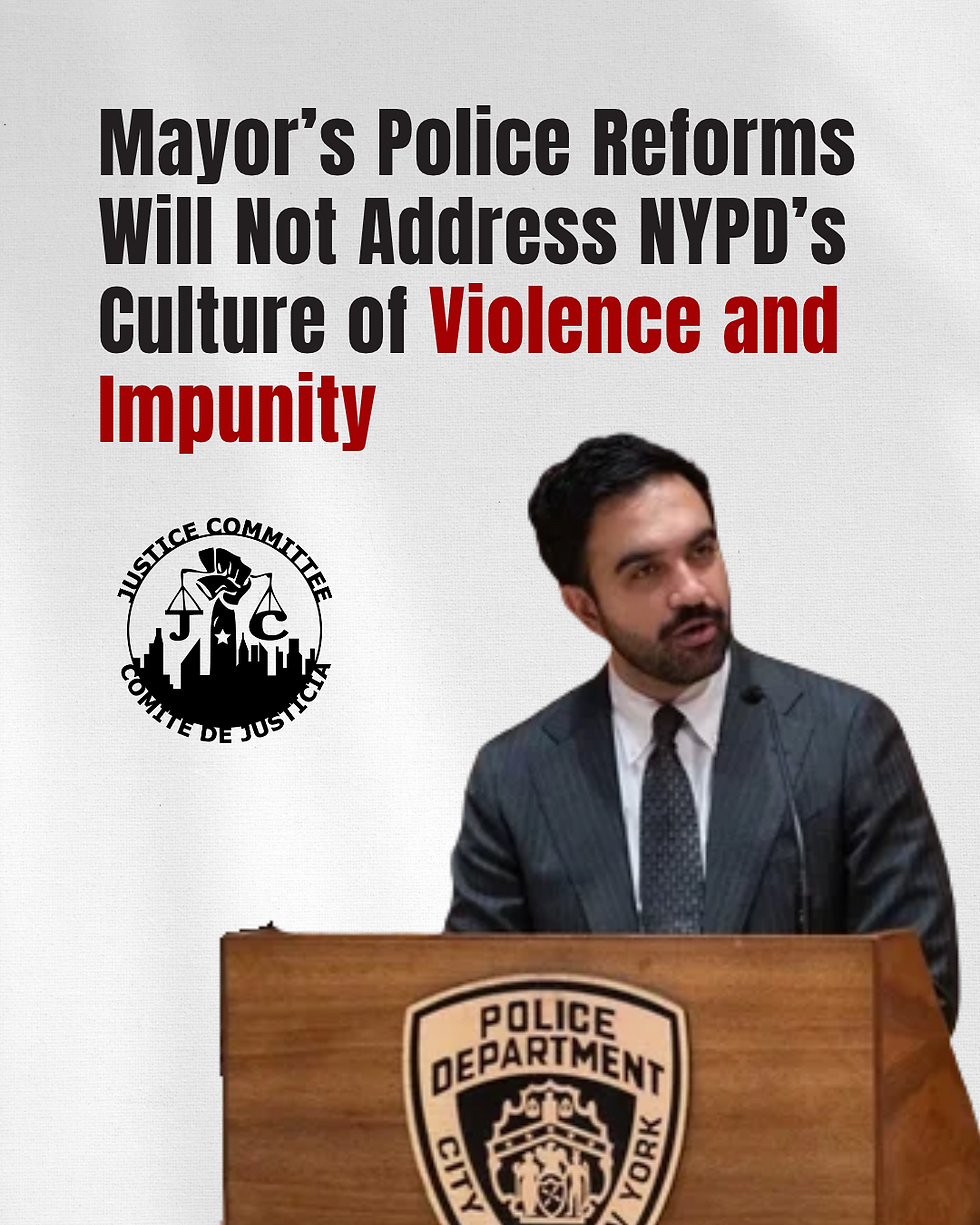
On top of this, the NYPD’s rising misconduct rates, abusive quality-of-life policing practices (e.g., stop-and-frisk), and culture of impunity normalize blatant attacks on community members and create a culture of fear, violence, and powerlessness against the state.
In authoritarian consolidation, local and federal law enforcement coverage is in overdrive. If we allow the MAGA project to continue down the path it’s on without intervention, the likely outcome is bleak: the seamless integration of all law enforcement as the repressive arm of a fascist regime. The prison-industrial and deportation-industrial complexes will not only persist under these conditions, but they will expand and thrive, and we will reach unfettered levels of social control, with mass surveillance, policing, and punishment even more deeply embedded into the fabric of everyday life.
While there may be moments along the way when local and federal law enforcement appear to be at odds as states feebly attempt to resist federal overreach, this will not erase the reality that the big-picture purpose of all law enforcement is the same: to serve state and elite interests.
Even if the current MAGA regime implodes of its own volition — which it might — without urgent action grounded in astute analysis, we will still end up living with the institutionalized remains of authoritarianism. We’ll be faced with further normalization and empowerment of draconian local and federal law enforcement and increased criminalization of our communities. The predictable demobilization of the left, which will come with the sigh of relief that “at least Trump is gone,” will leave the door wide open for compounded police power and the silencing of anyone who objects.
What do we do?
So, in these terrifying times, what do we do? As the Trump regime deports more and more people, at times to certain death, and accelerates its brand of imperialism — from Gaza, to Venezuela, to Cuba to Iran — how do we build the power necessary to resist?
First, we must ground ourselves in a clear analysis: Policing, immigration enforcement, and the broader carceral system are tools used to maintain racial capitalism and the U.S. imperial project. The further militarization and integration of policing systems has paved the way for and reinforced the authoritarian takeover, and efforts that focus on reforming and retraining these systems lead us woefully in circles. Whether we’re fighting MAGA or a more “liberal” regime, we must consistently focus on organizing that reduces the power and scope of policing and the broader carceral state.
Second, we must regroup and recommit to real grassroots organizing. This is more than just public education, one-off rallies, or disconnected mutual aid and rapid response. All of these are worthwhile tactics, but they must be woven into a coherent strategy to be effective in transforming our material conditions. As prolific activist and Justice Committee co-founder Richie Perez often said, we need “any and all tactics” — not just in the sense of using every tool available to us, but in strategically integrating them toward clear goals.
Organizing is the sustained work of developing and centering the leadership of directly impacted people, building collective strategy, and waging campaigns with clear targets and demands that build power and shift conditions. Mass mobilization can be an important tool in organizers’ box of tactics, but simply calling for “justice” or marching under broad slogans like “no kings,” without identifying who holds power and what must change, and then strategically escalating pressure, does little to force concrete outcomes.
For example, in New York in 2020, we were able to channel the momentum of the uprisings into real power building and tangible victories, because the Justice Committee and dozens of allies had already spent years building alignment and cross-sector coordination through Communities United for Police Reform. With the unwavering leadership of families whose loved ones were killed by the NYPD, we waged disciplined campaigns that combined mass mobilization, direct action, public education, advocacy, strategic communications, and legal tactics to win the repeal of the “police secrecy law” (CRL 50-a), the passage of special prosecutor legislation, and the reduction of the NYPD budget by close to $350 million for FY 2021, among other victories. While imperfect, these victories set the stage for future organizing. For example, the repeal of CRL 50-a is how we know that the officer who killed Allan Feliz has a history of 40 misconduct allegations, a fact that has been instrumental in the campaign to ensure he is fired. Similarly, today we see how sustained, multifaceted, community-led resistance to immigration raids in Minnesota helped force the withdrawal of some ICE agents.
In these fraught times, this foundation of disciplined organizing also requires heightened attention to security and self-determination. As the state expands its surveillance capacity and proves itself unwilling (or unable) to ensure our safety, more people are recognizing that our security must come from each other. To that end, people are increasingly building networks outside of formal institutions, using encrypted communications, conducting Know Your Rights trainings, and developing rapid-response infrastructure to protect their hyperlocal communities. This shift is not incidental; it is a necessary adaptation to an environment where “public safety” institutions function as instruments of control rather than protection.
Third, we must build cross-sector solidarity and collaboration. “Criminal” and immigration enforcement are deeply intertwined, and attempts to portray local police as “real” or “good” law enforcement in contrast to ICE and CBP are misguided and dangerous. Our demands should aim to simultaneously reduce federal and local law enforcement power and collaboration. Now is the moment to de-silo our movements; align analyses, strategies, and narratives; and recognize that our struggles are interconnected.
Part of this means not letting local officials and police departments off the hook. Rather than futilely calling on local police to save us from ICE, we should be demanding a stop to joint task forces, data and resource sharing, and other collaborations that empower local law enforcement agencies to further criminalize and punish immigrants. Even as we confront federal overreach, cities and states like New York continue to expand police budgets, surveillance infrastructure, criminalization, and the suppression of dissent under the guise of “public safety.” In New York, this means fighting to remove the NYPD from mental health response, schools, and other social service roles, ensuring real investments in noncarceral mental health care and crisis response, and challenging the police commissioner’s unchecked authority over police discipline, which fuels the NYPD’s violence with impunity.
This work requires us to reckon with the severity of state violence and how the long-lasting trauma of living under its thumb impacts our day-to-day lives, and to foster a culture of mutual care in its wake. Building on this foundation, it means harnessing community power to mobilize coordinated, strategic militant resistance that transforms oppressive systems, using any and all tactics to bring us closer to liberation. No one person in this movement stands alone, and in acting together, what we sow now will be reaped for many generations to come.
By combining militant, organized resistance with rigorous political education, we can transform individual outrage into collective action and power. This is how movements threaten the system and can, with sustained resistance, dismantle it. This is how we win.
Conceived of and authored by Justice Committee staff & members:
Aubergine Yuen
Christine Henson
David Galarza
Henna Kaur
Jon McFarlane
Susan Hadley
Tess Weiner, Communications Coordinator
Yul-san Liem

https://mm88.observer/ là cái tên mình bắt gặp khi đọc một bài viết về thói quen theo dõi thu chi trên thiết bị di động. Một liên kết nằm gần phần nội dung giải thích nên mình bấm vào xem thử trong lúc nghỉ giữa giờ. Mình chỉ dành vài phút quan sát giao diện, chú ý cách các thông tin được sắp xếp thay vì đọc từng chi tiết. Tổng thể nhìn tương đối gọn, các khu vực không chen chúc nhau và thao tác chuyển qua lại khá dễ hiểu ngay từ lần đầu ghé thăm.
GG88 là cụm mình bắt gặp trong một bài viết tổng hợp các thuật ngữ thường xuất hiện sau những trận đấu trực tuyến. Ban đầu mình chỉ định xem nghĩa của vài từ viết tắt để hiểu nội dung bài, nhưng thấy có đường dẫn liên quan nên mở thử luôn. Mình không ngồi tìm hiểu lâu, chỉ xem qua trang chính và chú ý cách các mục được sắp xếp. Phần tiêu đề khá dễ nhận ra, nội dung không bị dồn thành một khối dài nên lướt nhanh vẫn nắm được bố cục chung.
Hôm trước, mình nghe vài người nói giao diện U888 có thay đổi nên cũng ghé vào xem thử cho biết. Mình chủ yếu quan sát cách trình bày chứ không bấm vào từng trò để tìm hiểu. Các phần trên trang được chia thành khu vực riêng, trong đó thể thao và live casino nằm tách biệt nên khá dễ phân biệt. Thông tin hiển thị theo cột, còn danh sách slot được gom vào từng sảnh game. Mình thấy cách sắp xếp này giúp trang trông đỡ rối, nhất là khi có nhiều danh mục xuất hiện cùng lúc. Menu nằm ngay chỗ dễ nhận ra nên việc chuyển mục cũng tương đối thuận tiện. Mình chỉ xem qua…
Some articles compel me to slow down because the subject matter is rather sensitive, and content regarding the grief of losing a pet is one such instance. Previously, I had encountered the topic https://kp88nv.com/ of reward-based card games—often associated with leisure and passing the time. Placing these two subjects side by side, I realiz Some articles compel me to slow down because the subject matter is rather sensitive, and content regarding the grief of losing a pet is one such instance. discussing how to cherish memories and allow oneself to grieve is written with great restraint, avoiding the trap of offering hollow words of encouragement.
https://qs88.works/ hôm trước mình thấy bạn bè nhắc thoáng qua nên bấm vào coi thử giao diện thế nào thôi. Mình không có ngồi mò từng mục hay chơi gì cả, chủ yếu xem cách họ sắp xếp trang cho dễ nhìn không. Ấn tượng đầu là tông màu xanh với vàng nhìn khá “sạch”, chữ với icon nổi vừa đủ nên không bị chói. Mấy khối nội dung chia theo nhóm rõ ràng, lướt xuống là hiểu ngay mình đang ở phần nào, chuyển qua lại cũng không phải bấm nhiều. Nói chung kiểu bố cục này hợp với người vào xem nhanh, không cần đọc dài dòng vẫn nắm được. Nhìn kỹ thì phần menu và các khung…